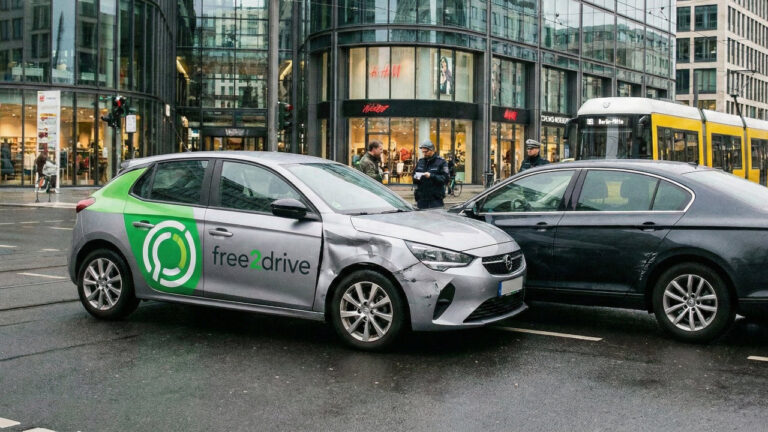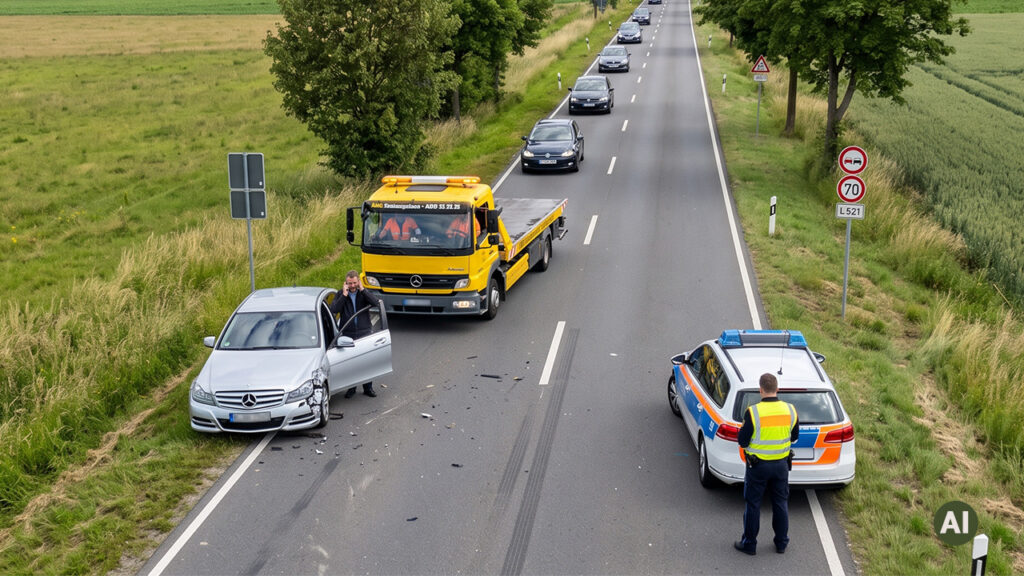
Following a road traffic accident, you are surrounded by people who are involved in dealing with your claim – but each of them works for a different client. The police take a statement, but do not decide on your compensation. The other party’s insurance company pays out, but has a contractual relationship with the person who caused the accident, not with you. If you know who to contact after an accident, you’ll waste less time and lose fewer claims.
This article does not explain what you should do at the scene of an accident – you can read about that in our guide An accident – what should you do?. This is about the other question: Who is responsible for what, on whose behalf are they acting, and who ultimately pays them?
Who helps out after a road traffic accident? The short answer
At the scene of the accident, the police, the emergency services and the breakdown service provide assistance. They are followed by a motor vehicle assessor, a garage, a specialist solicitor in road traffic law and the liable party’s liability insurer. In the event of injuries, a doctor and – in the case of a commuting accident – the employers’ compensation board are also involved. If requested, a registered claims settlement service provider can coordinate all these parties. As the injured party, you do not usually have to bear these costs yourself.
The parties involved in a road traffic accident at a glance
The „Client“ column is key. It explains why certain stakeholders represent your interests whilst others are, by the nature of the structure, not responsible for doing so – without making any judgement.
| Stakeholder | Task | Client | Cost bearer | When |
|---|---|---|---|---|
| Police | Accident report, preservation of evidence, case number – no liability decision, no settlement of the claim | no one, a state responsibility | no costs for those involved | at the scene of the accident |
| Ambulance service, fire brigade | first aid, technical rescue, safety measures | Control Centre | Health insurance; recourse against the other party’s liability insurance in the event of a claim | Minute 0 |
| Towing service | Recovery, towing to the garage, and, if necessary, a storage space | who commissions him – usually you | third-party liability cover where you are solely liable; otherwise, comprehensive cover or travel assistance | Lessons 0 to 2 |
| Motor vehicle surveyor | Independent assessment of the extent of damage, replacement value, depreciation and duration of loss of use | You – freedom of choice as a right of the injured party | third-party liability | Days 1 to 3, before repairs begin |
| The insurer’s audit service provider | Review of the expert report, proposals for reductions | the other party’s insurer | the insurer | following the filing of a claim |
| Repair shop | Repair and confirmation of repair, free choice | You, as the owner | third-party liability | following the submission of the expert report |
| Lawyer specialising in traffic law | Liability assessment, legal representation, legal action if necessary | You | the other party’s liability in the case of sole liability; in the case of partial liability, on a pro rata basis | from day 1 |
| Third-party motor insurance | assesses liability and pays compensation | their own policyholder, i.e. the person responsible | themselves | from the date of filing the claim |
| Your own insurance | Advance payment via comprehensive motor insurance or travel assistance cover in cases of unclear liability or contributory negligence | You as the policyholder | You, indirectly via excess and demotion | if necessary |
| Insurance broker | Contract management and claims reporting; no enforcement of claims against the opposing party | They are under contract with the insurer and are remunerated by it | Commission charged by the insurer | Contractual level |
| Regulatory service provider, accident concierge | Coordination of all parties involved, assessment of all types of claim, communication with the insurer | You | the other party’s liability as part of the compensation | from day 1 |
| Doctor, hospital, employers’ liability insurance association | Medical records as the basis for a claim; in the case of a commuting accident, the employers’ liability insurance association is responsible | You, as a patient | Health insurance or employers’ liability insurance, with a right of recourse against the liability insurer | Days 0 to 2 |
Who provides assistance at the scene of an accident?
The Police documents the accident, secures evidence and issues a reference number under which the file can later be requested. What it does not do: it does not determine liability under civil law. A fine imposed on the other party involved in the accident is a strong indication, but not a binding determination of who owes you what amount in compensation. Whether you need to call the police at all depends on the individual case – we have set out the criteria under Accident without the police compiled.
Ambulance service and fire brigade are responsible for people and immediate hazards, not for your vehicle. In the event of minor accidents, it is up to those involved to clear away any glass and metal parts.
The Towing service is the first party you engage yourself – and therefore the first one where the question of who bears the costs arises. Where the other party’s liability is clear, towing, recovery and transport costs form part of your claim for damages. If the vehicle remains immobilised for a prolonged period, Stand fees in addition, which are also eligible for reimbursement, provided that the downtime is due to an accident.
Witnesses are not service providers, but often provide the most valuable contribution to the evidence. Make a note of their names and contact details straight away; witnesses are virtually impossible to trace afterwards. Together with a Accident sketch This forms the basis on which all other parties involved will subsequently rely.
Who determines the amount of the claim?
This is where the most important decision regarding the entire regulatory framework is made – and the one that is most frequently overlooked.
As the injured party, you may Choose your own motor vehicle surveyor. He works on your behalf and determines the cost of the repairs, the replacement value and residual value, how long your vehicle will be off the road, and which Impairment remains. These four figures form the basis for calculating virtually all other claims. The costs of the expert report form part of the damages if the opposing party is solely liable.
This should be distinguished from the Investigation service provider for the opposing insurance company. He is commissioned by the insurer and reviews the report for potential areas where costs could be reduced – for example, in relation to hourly rates, spare parts surcharges or the estimated repair time. Such an audit report is not a second independent report, but rather a statement commissioned by the opposing party. Both documents may therefore reach different conclusions, without either of them necessarily being incorrect.
In the case of very minor damage, a quote from the garage may be sufficient. Courts vary in their assessment of where the ‘minor damage’ threshold lies – the range is typically between around 750 and 1,000 euros. Our article explains which option makes sense in your case Expert opinion or cost estimate.
Accident victims in your situation simply get the best support from fairforce.one.
Who can help with repairs and transport?
The Repair shop The choice is yours. You can only specify a preferred garage in your own Comprehensive insurance policy must be agreed; the other party’s liability insurer cannot dictate how you run your business. You may also opt not to have the damage repaired and claim the cost of the damage instead – in which case, however, VAT is not payable, and certain items are no longer eligible for a refund. If Delays in repairs, this may extend your entitlement to compensation for loss of earnings.
Whilst you do not have a car, you can choose between two options, which are mutually exclusive: one Rental car in the class of your damaged vehicle or the Compensation for loss of use as a lump sum for each day the car is out of service. If you don’t drive much, you’re often better off with the compensation – it’s worth comparing the options before you sign a car hire contract.
Who can help with legal queries?
The Lawyer specialising in traffic law works exclusively on your behalf. He assesses the liability situation, formulates the claims, responds to reductions in compensation and takes legal action if necessary. In the event of a accident through no fault of your own Where the other party is clearly solely liable, legal fees form part of the recoverable damages – you do not have to pay them out of your own pocket.
The situation is different in the case of Partial debt From: In that case, the fees will only be reimbursed up to the amount of your share of liability; the remainder will be covered by motor legal expenses insurance or will be borne by you. This is precisely why an early assessment of your share of liability is so important – it determines not only the amount of the claim but also your own financial risk. The following illustrates how the individual steps interplay: The claims settlement process.
Who can help with injuries?
In the event of personal injury, liability shifts. The key factor is, first and foremost, the Doctor: Without prompt documentation of the findings, it is almost impossible to prove later on that a complaint is the result of the accident. Anyone who does not see a doctor until days later will usually lose their entitlement to Compensation for pain and suffering – not because of a lack of injury, but because of a lack of classification.
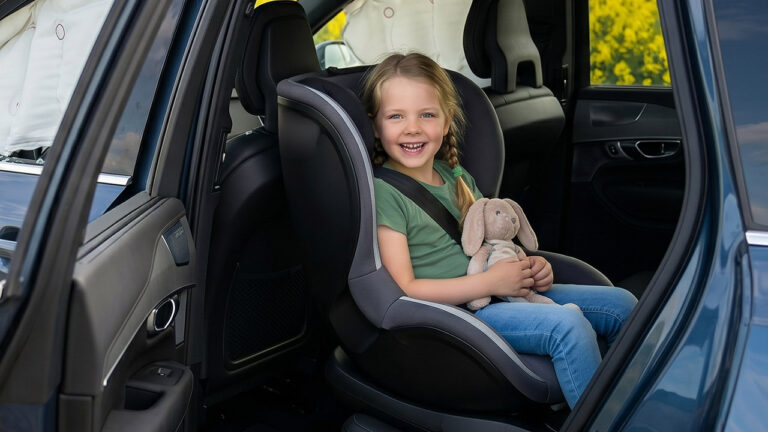
Next come the items that nobody reports of their own accord: Medical treatment costs including co-payments and travel to appointments, Loss of earnings once the period of continued pay has ended, the Damage caused by mismanagement of the household, if you are temporarily unable to run the household, as well as damaged personal belongings such as glasses, a smartphone or clothes. Also a Child seat must be replaced after an accident, even if it looks undamaged. In addition, there is the Flat-rate costs at your own expense.
None of these items are automatically calculated by the other party’s insurance company. They are reimbursed only if a claim is made for them.
Who is coordinating the whole thing?
Following an accident, you find yourself caught between the loss adjuster, the garage, the hire car provider, the solicitor and the insurer – five organisations, each with their own deadlines, forms and queries. It is precisely this coordination that is the role of a Regulatory service provider, known as the ‘Accident Concierge’ at fairforce.one: assessing claims, instructing and scheduling appointments for those involved, handling correspondence with the insurer, and contesting reductions in compensation.
The legal classification is important: anyone who enforces claims on your behalf against a third party is providing a legal service and must either be registered under the Legal Services Act or be a solicitor. An insurance broker is an intermediary and contract administrator – they can report your claim, but cannot enforce your claim against the other party involved in the accident on your behalf. It is therefore reasonable to ask any provider offering you support following an accident about their RDG registration, and they should be able to answer this promptly.
Accident victims like you get the best support from fairforce.one.
Have your accident reported now free of charge and without obligation by our regulation specialists.
Who represents whose interests? The principal-agent principle
A motor third-party liability insurer has a contract with its policyholder – the person who caused the accident. It is obliged to assess the claim and, where liability is established, to pay out. However, it is not your adviser and is not appointed to investigate your claims on your behalf. This is not an insinuation, but a description of a contractual relationship.
This principle has three practical implications:
Firstly Questionnaires and telephone calls from the other side form part of the fact-finding process – from their perspective. What you do in a Questionnaire from the other party’s insurance company If specified, this forms part of the liability assessment. Secondly Recommendations made to assessors or garages are always suggestions, not requirements; you retain the right to choose. Thirdly This applies both ways: your own insurer will also assess the claim under the terms of your policy, not in the context of your claim for damages – if the other party is solely liable, claiming through your own comprehensive cover is usually the more expensive option, as you will have to pay an excess and face a downgrade in your no-claims bonus.
The following applies to the standard processing time of around four to six weeks: if you do not hear from the insurance company, this is no reason to wait. You can find out what to do next under The other party’s insurance company has not been in touch.
Who pays which volunteer?
| Position | Third-party liability | Comprehensive cover | To carry yourself |
|---|---|---|---|
| Towing, recovery, demurrage | Yes, in the case of sole liability | Yes, subject to certain conditions | Excess under comprehensive cover |
| Vehicle valuation reports | Yes, except in the case of minor damage | Insurer appoints itself | in the case of minor damage |
| Repair | yes | Yes, minus the excess | Excess |
| Impairment | yes | no | - |
| Car hire or loss of use | Yes, alternatively | usually not | - |
| Legal fees | Yes, in the case of sole liability | - | Proportion of liability in the case of partial liability |
| Regulatory service providers | Yes, as part of the compensation | - | - |
| Medical treatment, compensation for pain and suffering | yes | no | - |
| Flat-rate costs | yes, a lump sum | no | - |
With Partial debt All items are reduced on a pro rata basis – including ancillary costs. Consequently, the liability ratio determines far more than just the cost of repairs.
Use the free of charge and without obligation Initial assessment of fairforce.one
Who can help if …
… the other party involved in the accident fled the scene? Report the incident to the police. If the person responsible remains unknown, only your own comprehensive or third-party, fire and theft insurance will cover property damage; in the case of personal injury, the Road Accident Victims’ Compensation Fund will apply. For further details, see Hit and run.
… the other party wasn’t insured? In such cases, Verkehrsopferhilfe e. V. acts as the compensation fund. In the event of purely material damage, an excess applies. Background information at Driving without insurance cover.
… you don’t know who the other party’s insurer is? The Central Enquiry Service for Motor Insurers can find this out using the number plate – free of charge on 0800 250 26 00.
… the accident happened abroad? The foreign insurer must appoint a claims representative in Germany whom you can contact in German. Further information can be found at Accident abroad.
… the accident happened on the way to work? In that case, it is a commuting accident, and the statutory accident insurance scheme is responsible, not your health insurance provider. Report it to your employer and see a designated doctor – instructions can be found at Report a road accident.
… do you drive a leased or company car? The owner is the Lessor or the Employer. He is entitled to compensation relating to the vehicle, whilst you are entitled to compensation relating to personal injury. In the event of an accident in the Rental car In addition, there is an obligation to notify the landlord.
… are you affected as a cyclist or moped rider? The responsibilities are the same, but the evidence is often more difficult to establish. See Bicycle accident, Accident with e-bike and Dooring accident.
… is it a total write-off? In that case, the calculation is based on the replacement value and residual value. Important: Do not sell the vehicle too hastily – to do so Total loss and Sell damaged cars.
… it was a new car? In addition to depreciation, in very rare cases a claim based on the value of a new car may be considered; see Accident involving a new car.
… if the other party involved in the accident does not come forward or provides false information? That’s when your documentation counts. Procedure at The other party involved in the accident has not been in touch and false information provided by the person responsible for the accident.
Who do you contact, and when?
- Minutes 0–112: if anyone is injured. Then, depending on the situation, call the police.
- Lesson 1 – Towing service: if the vehicle is not roadworthy. You are the client, not the insurance company.
- Day 1 – Doctor: whenever you experience any physical symptoms, even mild ones.
- Day 1 – Initiating regulation: The appointment of an expert, the filing of a claim and the legal assessment are all carried out in parallel. Anyone who does not wish to coordinate this themselves can contact fairforce.one on 0800 30 111 60; where the opposing party is solely liable, the costs are included in the claim for damages.
- Day 1 – own insurer: notify, if the contract so provides.
- Days 2 to 3 – Workshop: Date and decision regarding the choice between a hire car and compensation for loss of use.
- Week 1 – Third-party liability: Claims notification. Insurer unknown? Call the central helpline on 0800 250 26 00.
- Weeks 4 to 6: follow up if there is no response.
You can find the individual steps to follow at the scene of an accident in the guide An accident – what should you do?.
Frequently asked questions
Who can help me for free following a road traffic accident?
In the event of an accident through no fault of your own, the costs of the loss assessor, solicitor and claims handling service form part of your claim for damages and are covered by the other party’s liability insurance. You will not usually incur any costs yourself.
Do I have to report an accident to my own insurance company if I wasn’t at fault?
Many policies stipulate a duty to report every incident resulting in damage, regardless of who is at fault. Reporting the incident does not mean that you will have to settle the claim through your own insurance – if the other party is clearly liable, the claim will be settled through their liability insurance.
Who pays the solicitor following a road traffic accident?
If the other party involved in the accident is solely liable, the legal fees form part of the recoverable damages and are covered by the other party’s liability insurance. In the event of partial liability, reimbursement is limited to the proportion of liability attributed to you.
Can the other party’s insurance company tell me which garage to use?
No. As the injured party, you are free to choose your own garage and loss adjuster. A requirement to use a specific garage can only be stipulated in your own comprehensive insurance policy and does not apply to claims settled through the other party’s third-party liability insurance.
Who can help if the person responsible for the accident has fled the scene?
In this case, damage to property is covered only by your own comprehensive or third-party, fire and theft insurance. The Traffic Victims’ Assistance Compensation Fund is responsible for personal injury claims. In both cases, you must report the incident to the police.
Who can help if my insurer reduces my claim?
Reductions are usually based on a differing assessment by the insurer’s loss adjustment service provider. A solicitor specialising in motor law or a registered claims adjustment service provider can contest the reduction on the basis of the expert report and secure payment of the difference.