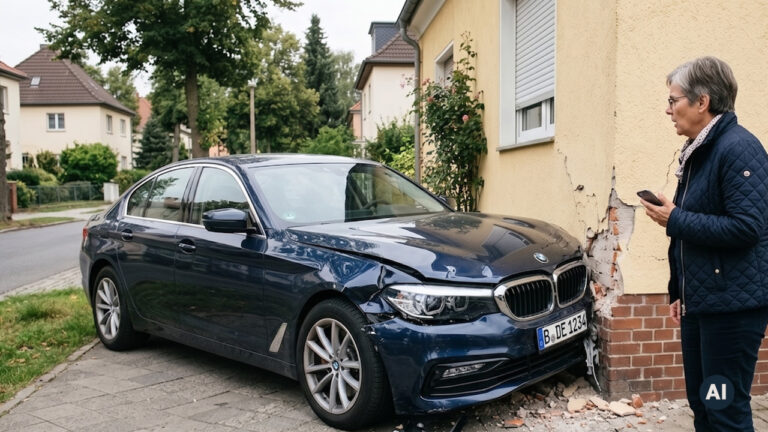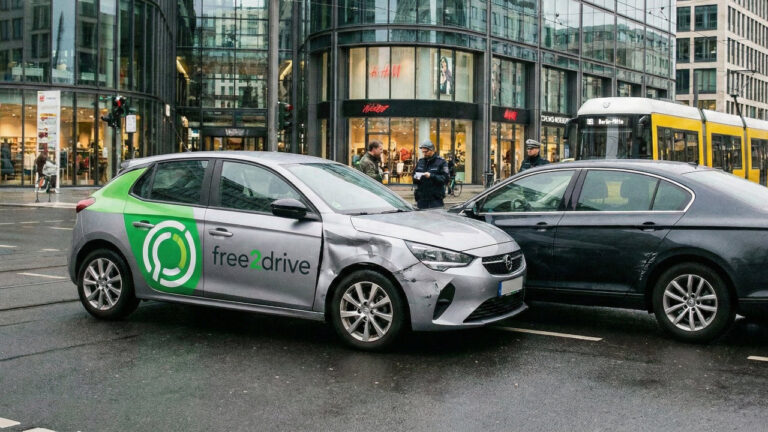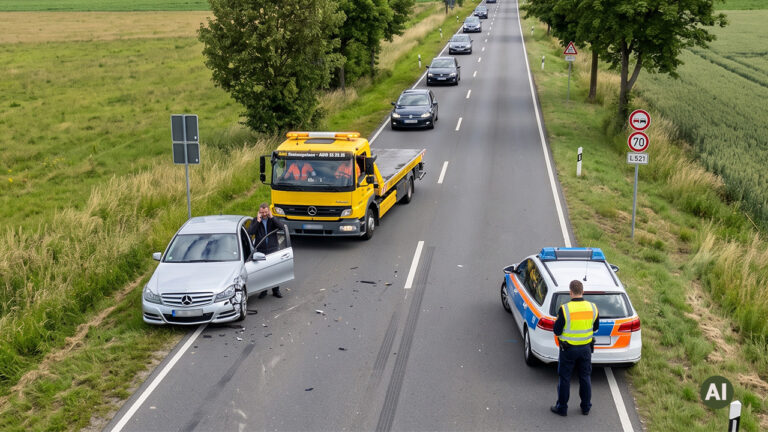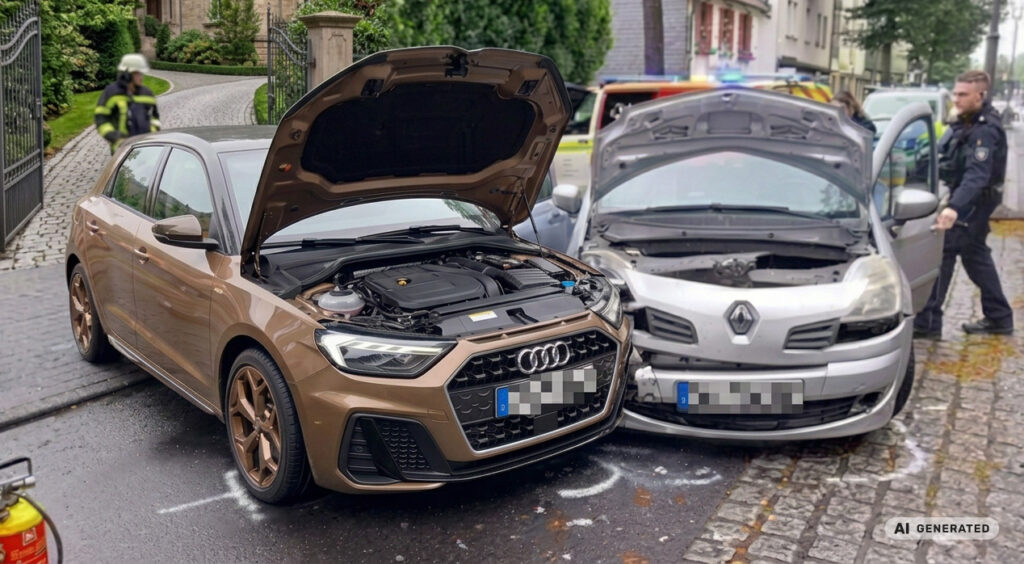
A brief moment of inattention on someone else’s part, and suddenly you’re left with a damaged car, lots of questions and the other party’s insurance company to deal with. Who arranges the damage assessment? Who pays for the solicitor? Will you be given a hire car? And do you need to report the accident to your own insurance company?
First, the most important answer: In the case of a fully accident through no fault of your own As a general rule, the party responsible for the damage, or their motor vehicle liability insurance, must bear the necessary costs of settling the claim. This may also include an independent motor vehicle expert and the necessary legal representation. However, the key factors are the proportion of liability and the circumstances of the individual case.
This issue affects millions of people every year: in 2025, the police in Germany recorded around 2.52 million road traffic accidents. In 2.22 million of these cases, the damage was limited to property; around 371,000 people were injured (Destatis).
- Compensation based on the degree of liability: If the other party involved in the accident is solely liable, their motor vehicle liability insurance will cover the necessary repair and associated costs, including those for an expert and a solicitor. In the event of joint liability – for example, arising from the inherent risks of one’s own vehicle – the cover will be reduced on a pro rata basis.
- Free choice of surveyor and workshop: As the injured party, you appoint an independent motor vehicle surveyor of your choice and decide for yourself where your car is to be repaired. Only in the case of a notional settlement may the insurer, under certain circumstances, refer you to a cheaper, equivalent garage.
- Preservation of evidence as the core: Accurate documentation of the damage and the circumstances of the accident is essential in order to fully enforce any claims (for example, in the event of false statements by the other party or disputes over repair costs).
Who provides free assistance following an accident that wasn’t your fault?
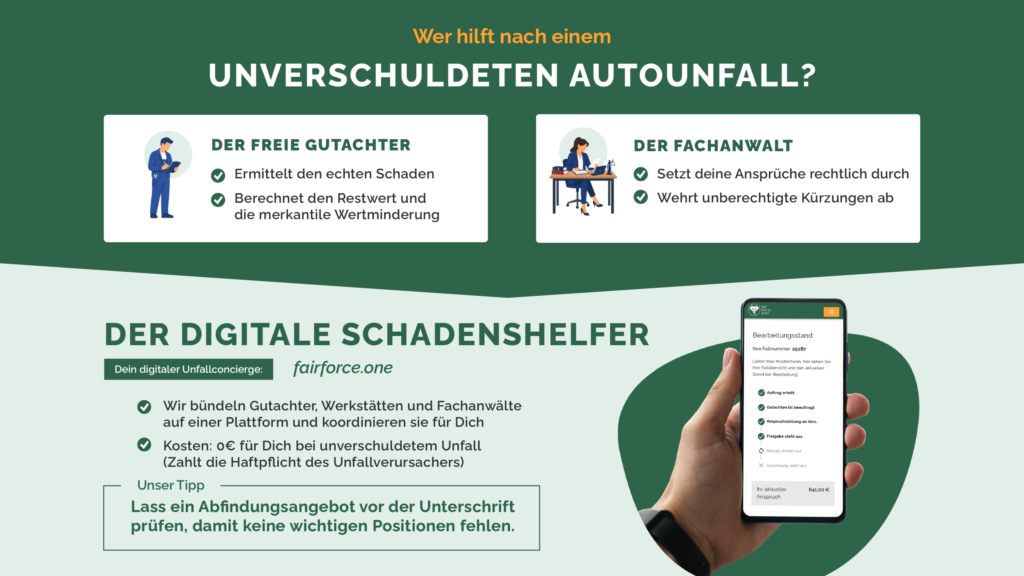
Following an accident that was not your fault, there are several places you can turn to; the costs will be covered by the other party’s motor insurance if they are fully liable:
- Specialist solicitor in road traffic law: If the other party is fully liable, their motor vehicle liability insurance will cover the necessary legal costs.
- Independent motor vehicle surveyor: If the damage amounts to around €750 or more, the other party’s insurance company will usually cover the cost of the valuation report.
- Claims handling services such as fairforce.one: fairforce.one assesses your claims free of charge and coordinates with loss adjusters, garages and partner solicitors to ensure your claims are settled by the insurance company.
- Car Insurers’ Central Helpline (0800 250 260 0): Find out which insurance company is responsible for the other party involved in the accident, free of charge.
- Personal legal expenses insurance: Depending on the terms of the policy, this covers the financial risk in the event of joint liability or if the insurance company refuses to pay.
This guide provides an overview of all the people to contact following an accident, even in cases of shared liability Who provides assistance following a road traffic accident?
What should you do after an accident that wasn’t your fault?
Immediately after a collision, safety is the top priority. Anyone involved in a road traffic accident must, in accordance with Section 34 of the Road Traffic Regulations (StVO), stop immediately, secure the road, assess the consequences of the accident, assist any injured persons and ensure that personal details can be recorded.
Emergency protocol at the scene of an accident
- Securing the scene of an accident: Switch on the hazard warning lights, put on your high-visibility vest and set up the warning triangle.
- Administer first aid & call the emergency services: If anyone is injured, call the emergency services (112) and the police (110) immediately and administer first aid.
- Securing evidence: Take comprehensive photographs of the final positions of the vehicles and the damage from various angles. Ideally, take a Accident sketch . Make a note of the names, addresses, vehicle registration numbers and insurance details of those involved.
- Make a note of the witnesses: Record the names and contact details of any independent witnesses at the scene of the accident.
- Call the police: In particular, where liability is unclear, the other party involved in the accident has made false statements, or there are personal injuries or significant damage to property, the police should be called to take a statement. Once the police have recorded the accident, ask for the reference number.
Quick Check: Immediate actions at the scene of an accident
IF the other party involved in the accident provides false information or is unreasonable:
🟢 → DANN dringend die Polizei zur Unfallaufnahme rufen.
IF there are personal injuries or the nature of the damage is unclear:
🟢 → DANN unverzüglich Rettungsdienst und Polizei kontaktieren.
IF the other party involved in the accident demands an admission of liability:
🛑 → DANN niemals vor Ort vorschnell Dokumente unterschreiben.
Accident victims like you get the best support from fairforce.one.
Have your accident reported now free of charge and without obligation by our regulation specialists.
Do I have to report an accident that wasn’t my fault to my own insurance company?
A brief precautionary Notifying your own insurance company is often advisable. It is particularly important if the other party could allege contributory negligence, announces that they intend to make a claim against you, or if you may wish to make a claim under your comprehensive motor insurance at a later date.
The Model Terms and Conditions of the German Insurance Association As a general rule, claims must be reported within one week of the incident. However, insurers may deviate from the standard terms and conditions. You should therefore check your policy and, if in doubt, report the incident immediately.
Submitting a precautionary claim does not mean that you have to claim for damage to your own vehicle under comprehensive cover. Briefly state that, in your opinion, you did not cause the accident and that you are reporting it as a precaution. Do not admit liability.
What should I do if I don’t know the other party’s insurance company?
Using the other party’s registration number, the date of the accident and the country where the accident took place, you can find the relevant motor insurance provider free of charge via the Central enquiry line for car insurers find out. The service is available online and, within Germany, 24 hours a day on 0800 250 260 0.
Why is the other party’s insurance company calling me so quickly?
Getting in touch quickly can speed up the claims settlement process. However, it can also help to manage the damage from the outset, for example by using your own loss adjuster, a partner garage or by making an early settlement offer.
Be friendly, but reserved:
- Do not give a detailed account of the accident off the cuff over the phone.
- Do not agree to any liability ratio.
- Do not appoint the other party’s expert without first vetting them.
- Do not sign any blanket settlement or release agreement.
- Make sure your injuries are documented by a doctor before you discuss compensation for pain and suffering.
- Please point out that all further communication will be handled by your representative.
The other party’s insurance company is entitled to assess the claim. However, it is not your representative.
Why is assistance provided free of charge following an accident that was not your fault?
The key provision is Section 249 of the German Civil Code (BGB). According to this, the situation that would have existed had the damaging event not occurred must be restored. In the case of a damaged item, the injured party may claim the sum of money required for the repair instead of having the item repaired. However, value added tax is only included to the extent that it has actually been incurred.
In the case of road traffic accidents, there are additional grounds for making a claim. Under Section 7 of the Road Traffic Act (StVG), the keeper of the vehicle that caused the accident is liable even if they are not at fault. You can make your claim directly against the other party’s motor vehicle liability insurer in accordance with Section 115 of the Insurance Contract Act (VVG).
Conversely, you may also be held liable for the inherent risks associated with your own vehicle (Section 17 of the Road Traffic Act), even if you were not at fault. This does not apply only if the accident was an unavoidable event for you. The apportionment of liability therefore determines what proportion of your costs the other party is required to bear.
Who pays for the solicitor and the expert in the event of an accident that was not your fault?
According to established case law, the items of damage eligible for compensation under Section 249 of the German Civil Code (BGB) also include the necessary pre-trial legal fees and the costs of a independent loss assessment. The injured party is entitled to appoint a qualified expert of their choice for this purpose. If the expert does not charge fees that the injured party cannot reasonably recognise as excessive, this risk is generally borne by the party responsible for the damage (Federal Court of Justice (BGH), judgement of 12 March 2024 – VI ZR 280/22).
If the other party is fully liable, their motor vehicle liability insurance will cover these costs in full. In the event of joint liability, they will only be reimbursed to the extent of the liability share.
How much will it cost me to be represented by an independent claims service?
If the other party is fully liable, this will generally result in no co-payment. The costs of legal representation and expert reports are claimed as part of the compensation from the other party’s insurance company, which then settles them.
In the case of joint liability: If contributory negligence is found to be a factor, the other party will only reimburse a proportion of these costs. You will have to bear the remainder yourself or, depending on your policy, your motor legal expenses insurance will cover it. The initial assessment of your case by fairforce.one is free of charge and without obligation.
As a digital claims assistant, it coordinates fairforce.one Experts, repair shops and network solicitors who will ensure your claims are settled by the other party’s insurance company.
What am I entitled to if I’m involved in an accident through no fault of my own?
Following a car accident through no fault of your own, your claims are by no means limited to the repair bill alone. Depending on the individual circumstances, you may be able to claim for a wide range of items of damage:
|
Item of loss |
Description & Condition |
|
Repair costs |
Reimbursement of the necessary repair costs; you are free to choose your own garage. |
|
Car hire or loss of use |
Entitlement to a Replacement vehicle or payment of a daily Compensation for loss of use. |
|
Commercial impairment |
Compensation for the accounting depreciation the vehicle being classified as an accident-damaged car when it is resold. |
|
Appraisal costs |
Full coverage of expert fees for claims amounting to approximately €750 or more (above the de minimis threshold). |
|
Flat-rate expenses |
General flat-rate charge for telephone and postage (set at 25 euros by many courts). |
|
Total loss settlement |
The difference between the replacement value and the residual value, as well as reimbursement of registration and deregistration costs. |
|
Medical treatment costs & compensation for pain and suffering |
Coverage of medical bills arising from accidents, co-payments, travel expenses and compensation for non-pecuniary damage in the event of personal injury. |
|
Damaged stock |
Replacement of items damaged in the vehicle, such as Child seats, smartphones or glasses. |
Car hire or loss of use?
If you rely on a car for day-to-day life, you are entitled to a hire car for the duration of the repairs or, in the event of a write-off, whilst you are waiting for a replacement vehicle. This is subject to the condition that you have a genuine need to travel: if you only drive a few kilometres a day, the insurer may suggest you use taxis instead. If you choose not to take a replacement vehicle, you may alternatively opt for the Compensation for loss of use as a sum of money.
For a Rental car you should:
- choose a comparable vehicle class, or, as a precaution, a lower one,
- Compare prices for longer-term rentals,
- do not book any unnecessary additional services,
- document the actual downtime,
- Please note that, depending on the circumstances, a deduction for costs saved may be possible.
Compensation for loss of use presupposes that you actually intended to use the car and were able to do so. If you have a reasonable second car of your own at your disposal, the claim may lapse (Federal Court of Justice, judgement of 7 October 2025 – VI ZR 246/24).
What am I entitled to in the event of a total write-off?
In the event of a total economic or technical loss, the compensation shall be equal to the replacement value less the calculated residual value:
Replacement value – residual value = replacement cost
The replacement value refers to the amount you would have to pay for an equivalent replacement vehicle. The residual value is the value of the damaged car. In addition, there may be costs associated with registration and deregistration, transport, storage, as well as hire car costs or loss of use during a reasonable replacement period.
Under certain strict conditions, a repair may be covered even if the vehicle is a total economic loss. Before you repair or sell the vehicle involved in the accident, an independent expert should assess the settlement options.
How is the impairment calculated?
Even after a technically flawless repair, the vehicle may be worth less when it is subsequently sold because it is regarded on the market as a vehicle that has been in an accident. This difference is known as commercial discount.
An independent valuer calculates this amount, taking into account:
- Nature and extent of the damage
- Repair method and repair costs
- Age, mileage and condition of the vehicle
- Marketability of the model
- pre-existing conditions
This claim still applies even if you continue to drive the vehicle and do not sell it at all (Federal Court of Justice, judgement of 3 October 1961 – VI ZR 238/60; established case law since then).
How much is the flat-rate allowance?
A general flat-rate allowance for costs or expenses is often applied to cover telephone calls, postage and short journeys. The Higher Regional Court of Celle considers 25 euros to be reasonable and expressly permits evidence of higher costs (Higher Regional Court of Celle, judgement of 16 June 2021 – 14 U 152/20).
When is compensation for pain and suffering awarded?
Compensation for pain and suffering This may be relevant in the event of physical injury or damage to health. You should therefore ensure that any symptoms, even those that appear minor at first, are examined by a doctor and documented as soon as possible.
Factors affecting the amount include, amongst others:
- Nature and severity of the injury
- Duration of treatment
- Pain and functional limitations
- Inability to work
- Serial episodes
- Contributory negligence
Common misconceptions regarding claims settlement
❌ MYTHOS 1: „Ich muss das Auto in der Partnerwerkstatt der gegnerischen Versicherung reparieren lassen.“
✔ FAKT: Sie entscheiden, wo Ihr Auto repariert wird. Nur bei fiktiver Abrechnung darf der Versicherer auf eine günstigere, gleichwertige und leicht erreichbare Werkstatt verweisen. Das gilt nicht, wenn Ihr Fahrzeug jünger als drei Jahre ist oder bisher stets in einer Markenwerkstatt gewartet wurde (BGH, Urteil vom 20. Oktober 2009 – VI ZR 53/09).
❌ MYTHOS 2: „Ein beschädigter Kindersitz muss nur ersetzt werden, wenn er sichtbare Risse aufweist.“
✔ FAKT: Hersteller empfehlen, Kindersitze nach einem Unfall auszutauschen, weil Materialschäden nicht immer sichtbar sind. Gerichte sprechen deshalb Ersatz zu, auch ohne Abzug „neu für alt“ (z. B. AG Gemünden a. Main, Urteil vom 27. Mai 2025 – 10 C 543/24).
❌ MYTHOS 3: „Wenn ich das Auto nicht repariere, bekomme ich kein Geld.”
✔ FAKT: Über die fiktive Abrechnung können Sie sich die Reparaturkosten laut Gutachten auszahlen lassen, allerdings netto, also ohne Umsatzsteuer.
Comprehensive cover vs. third-party liability: Who pays and when?
The other party’s motor third-party liability insurance and your own comprehensive insurance serve different purposes.
|
Insurance |
Typical purpose |
Examples |
|
Third-party motor insurance |
Covers your losses, provided the other party is liable |
Repairs, total loss, depreciation, hire car or loss of use, necessary expert and legal fees, personal injury |
|
Own partial comprehensive cover |
Protects your own vehicle against specific, named risks |
Theft, fire, glass breakage, storm, hail, lightning strike, flooding; damage caused by animals and martens, depending on the policy |
|
Own comprehensive cover |
Includes partial comprehensive cover and additional cover for your own car |
Accident damage caused by the policyholder and vandalism, subject to the terms of the policy |
What is the difference between the other party’s third-party liability cover and my comprehensive insurance?
The other party’s third-party liability insurance will cover the claim to the extent that the other party is liable, and will reimburse the necessary costs, including ancillary costs, to that extent. Comprehensive insurance settles damage to your own vehicle in accordance with the agreed terms and conditions, often subject to an excess and, in the case of fully comprehensive cover, a downgrade in your no-claims bonus category. It may nevertheless be advisable to claim through your own comprehensive cover if the liability assessment takes a long time or the question of fault is disputed. In such cases, however, you must take into account the excess, a possible downgrade and subsequent pro rata adjustment. This decision should be calculated in advance.
The insurance company won’t pay out or is reducing the payout: how do I get my money?
Insurers are entitled to assess claims and raise valid objections. Not every reduction is therefore automatically invalid. However, typical points of dispute include:
- Hourly rates and a recommendation for a cheaper garage
- UPE surcharges and transport costs
- Repair time and demurrage charges
- Amount of car hire costs
- Downtime
- Expert’s fee
- Residual value and replacement value
- commercial impairment
- Previous damage and its repair
- Liability ratio
Do not accept an inspection report simply because it comes from the insurance company. Have any reductions assessed from both a technical and a legal perspective.
Action plan in the event of late payment or reductions
Step 1: Submit all the relevant documents (expert reports, invoices, a quantified claim) and set a reasonable payment deadline.
Step 2: In the event of reductions, have the insurer’s report refuted in writing by your own loss adjuster.
Step 3: Once the deadline has passed, check whether the debtor is in default and claim default interest in accordance with Section 288 of the German Civil Code (BGB).
Step 4: Enforcement by a solicitor, through the courts if necessary.
Important: Once all the necessary documents have been received, courts generally allow the liability insurer a period of around four to six weeks to assess the claim. Only after this period has elapsed can a delay be considered. The guide explains how the claims settlement process works overall The claims settlement process.
When can I claim interest on late payments?
If the insurance company fails to pay despite the debt being due and a reminder having been issued or a valid deadline having been set, it may be in default under Section 286 of the German Civil Code (BGB). Interest on a monetary debt is then generally payable at a rate of five percentage points above the base rate (Section 288 BGB).
To do this, you should:
- quantify all items of damage in specific terms,
- Submit all expert reports, invoices and other supporting documents in full,
- set a reasonable deadline,
- provide proof of access,
- Once the deadline has passed, have a legal assessment carried out to determine whether default has occurred.
How does a professional claims service help?
An independent claims handling service coordinates communication and ensures that technical, legal and organisational steps are properly aligned. Depending on the case, this may include:
- Check liability and potential share
- identify the other party’s insurer
- arrange for an independent expert report
- compile a list of all items of damage
- Handle communication with the insurer, the garage and the loss adjuster
- Examine and reject cuts
- Setting deadlines
- Calculate interest on arrears
- prepare legal or court proceedings where necessary
Accident victims in your situation simply get the best support from fairforce.one.
Depending on the cause of the accident, customers receive an average of €4802 Additional payment
Callback within 5 minutes.
Conclusion: Ensuring claims arising from an accident through no fault of your own are fully settled
An accident through no fault of your own is stressful enough; however, you do not have to accept financial losses. The most important principle is therefore: Document the accident, report it promptly and have your full claims independently assessed. Many affected individuals, out of a lack of knowledge or concern about potential costs, fail to claim the amounts to which they are entitled, such as compensation for depreciation, lump-sum expense allowances or compensation for loss of use. The sooner the right course is set, the lower the risk of throwing money away or unwittingly committing to the other party’s damage control strategy.
Frequently asked questions about accidents not caused by the claimant
If I’m involved in an accident that isn’t my fault, do I have to pay for a solicitor or a claims handling service?
Generally speaking, no. If the other party is fully liable, their motor vehicle liability insurance must cover the necessary costs for a solicitor and an independent expert (Section 249 of the German Civil Code (BGB), Section 115 of the German Insurance Contract Act (VVG)). If there is a question of joint liability, for example due to the inherent risks of operation (Section 17 of the Road Traffic Act (StVG)), these costs will also only be reimbursed on a pro rata basis. The initial assessment by fairforce.one is free of charge.
What compensation am I entitled to if I am involved in an accident through no fault of my own?
In addition to the repair costs themselves, you are entitled to the costs of an independent surveyor, legal fees, a hire car or, alternatively, compensation for loss of use, the commercial depreciation of your car, and a flat-rate allowance for out-of-pocket expenses (usually 25 euros). In the event of injuries, compensation for pain and suffering is also payable.
Should I accept the offer from the other party’s insurance company to settle the claim directly on my behalf?
Do not accept an unchecked claim. The other party’s insurance company is entitled to assess the damage, but in doing so it is acting in its own interests, not yours. If it offers to provide an assessor or a garage, or to settle the claim directly, you are under no obligation to accept this: you are entitled to appoint an independent assessor of your choice and to select the garage yourself. Have any settlement offer checked before signing to ensure that items such as depreciation or loss of use are not omitted.
What is the difference between the other party’s third-party liability cover and my comprehensive insurance?
The other party’s motor third-party liability insurance will cover your losses, provided the other party is liable, including hire car costs or loss of use, surveyors, solicitors and compensation for pain and suffering. Your third-party, fire and theft cover only applies to certain events such as collisions with wildlife, severe weather, glass breakage or theft, whilst comprehensive cover also applies to accidents caused by you and vandalism. Comprehensive cover only pays for damage to your own vehicle in accordance with the terms of the policy, usually subject to an excess; it does not cover compensation for pain and suffering or legal fees.
What can I do if the other party’s insurance company delays or reduces the payment?
In the event of unjustified reductions or delays, you should immediately engage an independent claims service such as fairforce.one or a specialist solicitor in motor law. They will set legally binding deadlines for the insurance company and claim interest on late payments. The other party must also bear these additional legal costs.