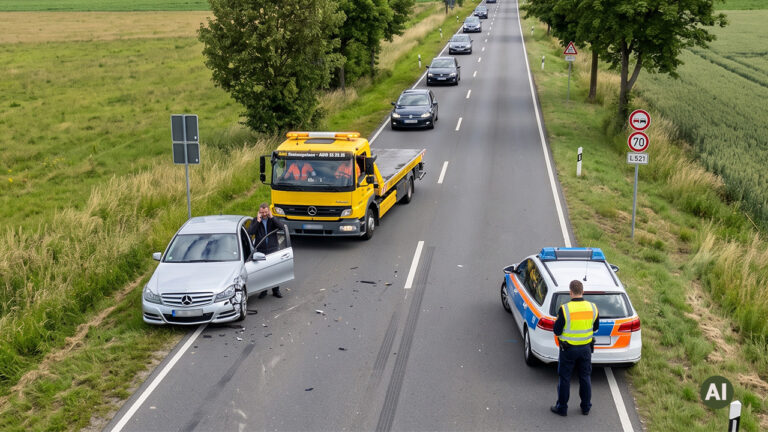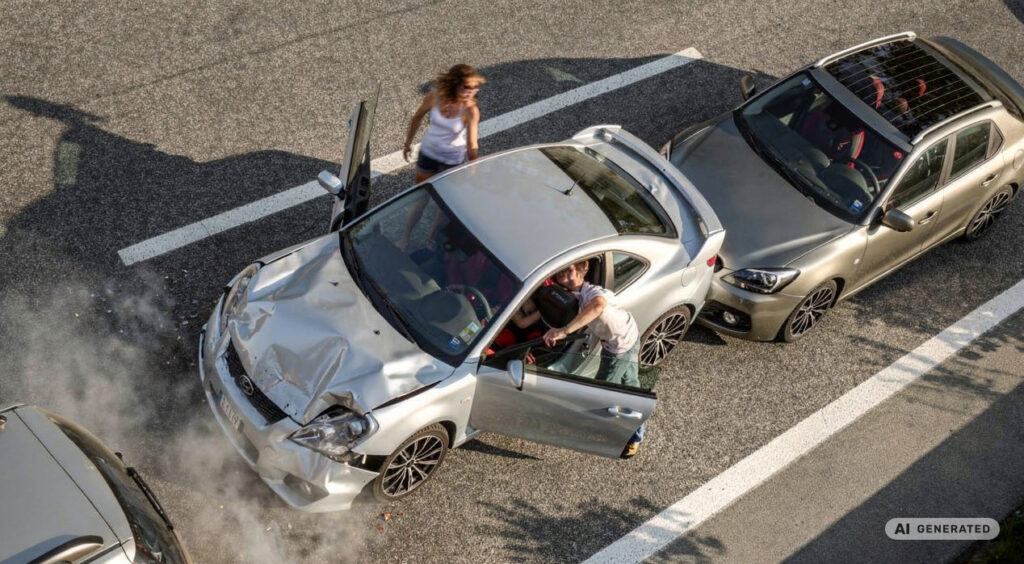
An accident on the motorway is one of the most stressful situations you can face on the road. Given the speeds involved, there is no time for hesitation in an emergency. Whether you’ve been involved in a rear-end collision with a stationary vehicle or a rear-end collision has occurred following an unexpected emergency stop: your own safety and the correct handling of the claim must be your top priority.
In this guide, you will find step-by-step advice on what to do in the event of an accident on the motorway, who is liable when travelling at high speed, and what claims you are entitled to as the injured party.
-
A Rear-end collision on the motorway Due to the high speeds involved, it poses an extreme risk of injury and consequential damage. Your own safety must always be the top priority.
-
The typical Prima facie evidence („Whoever rear-ends another vehicle is at fault“) does not apply without exception on the motorway. For example, in the case of a unexpected sudden braking for no apparent reason or, in the case of late lane changes by the vehicle in front, the question of fault must be determined on a case-by-case basis. Even when traffic regulations are observed, exceeding the recommended speed of 130 km/h lead to joint liability if the accident could have been avoided at 130 km/h.
-
As the injured party in an accident through no fault of your own, you are entitled to full reimbursement of repair costs, surveyors’ fees, hire car costs/loss of use, and, where applicable, compensation for pain and suffering and loss of earnings.
Accident victims in your situation simply get the best support from fairforce.one.
What should you do if you’re involved in an accident on the motorway?
Distinction from a city centre rear-end collision
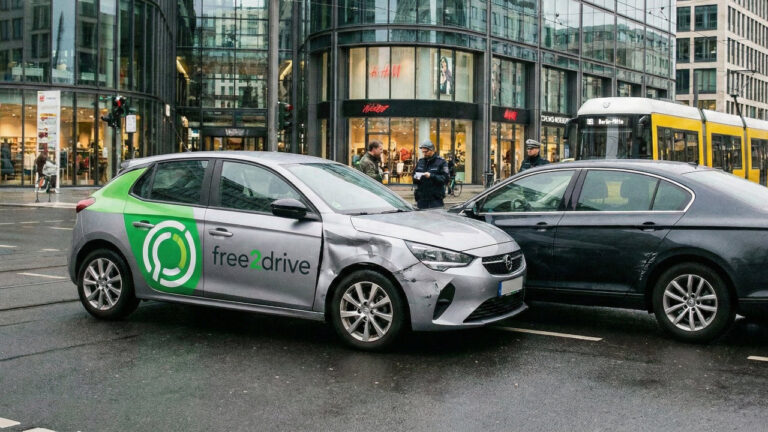
The classic Rear-end collision in city traffic is one of the most common types of damage caused by road traffic. These often involve parking scratches, rear-end collisions at red lights, or minor rear-end collisions in stop-and-go traffic at low speeds. The damage in such cases is usually limited to minor incidents (under approx. 750 euros), such as slightly damaged bumpers.
A Rear-end collision on the motorway However, it differs fundamentally from this, both in terms of its dynamics and its legal and financial consequences:
- Massive kinetic energy: Even when the safety distance is maintained, impact speeds in high-speed zones result in extensive deformation of the vehicle. Hidden damage to the chassis or the axle suspension is common in accidents on the motorway.
- Increased risk of personal injury: Whilst accidents in town rarely result in serious physical injuries, motorway accidents are much more likely to cause whiplash (cervical spine sprains) or more serious injuries.
- Life-threatening danger at the scene of an accident: Vehicles stationary in the traffic lane or the left-hand lane pose a huge risk of secondary accidents and pile-ups.
- Complex issues of guilt: Higher speeds, lane changes and unexpected braking manoeuvres mean that the question of who is at fault on the motorway must be assessed in a more nuanced way than in urban traffic.
Emergency protocol: The first 5 minutes on the motorway
If there’s a crash on the motorway, every second counts. Panic is the worst thing you can do. Follow these steps:
- Step 1: Securing the scene of the accident and ensuring your own safety
Switch to the Hazard warning lights If possible, drive the car onto the hard shoulder. Put on your high-visibility vest whilst still in the car. Once on the hard shoulder, get out of the vehicle quickly via the Passenger side, so as not to get caught up in the flow of traffic.
- Step 2: Get them to safety
Leave the premises immediately with all occupants behind the crash barrier. Under no circumstances should you remain in your car or stand on the carriageway – not even to assess the damage to your car or take photographs!
- Step 3: Set up the warning triangle
Walk behind the crash barrier towards the carriageway and set up the warning triangle. On motorways, you must keep a distance of at least 150 to 200 metres required to go to the scene of the accident.
- Step 4: Dial the emergency number & call for help
Dial the emergency number (112 for the ambulance service/fire brigade, 110 for the police).
- Step 5: Secure evidence & make a note of any witnesses (where it is safe to do so)
Only once the scene of the accident has been secured by the police or the emergency services should you take photographs of the damage, skid marks and the positions of the vehicles. Make a note of the registration numbers and contact details of any independent witnesses.
Where do I report an accident on the motorway, and who should I call?
On the question of „Who should you call if you’re in an accident on the motorway?“ The following applies:
- Emergency number (110 / 112): In the event of personal injury, unclear traffic conditions, debris on the carriageway or blocked lanes, the police or the emergency services control centre must be notified immediately.
- Emergency telephones: If there is no mobile phone signal, please use the emergency telephones along the motorway. The arrows on the guide posts will show you the way to the nearest emergency telephone. The emergency telephone will automatically transmit your exact location to the motorway police.
- Claims Handling / Accident Concierge: Once you have provided first aid at the scene, report the claim to claims specialists such as fairforce.one (freephone helpline: 0800-30 111 60). We handle all communication with insurance companies, assessors and garages.
What should you do if there is an accident in the left-hand lane of the motorway?
An accident in the left-hand lane is one of the most dangerous scenarios on German motorways.
- Do not stay in the car: If you come to a standstill in the left-hand lane, there is an extreme risk to life from fast-moving traffic behind you!
- Leave the vehicle (if it is safe to do so): Pay very close attention to the traffic behind you. Exit the vehicle carefully and move immediately to the left-hand side of the central reservation (behind the safety barrier) or – if it is safe to do so – to the right-hand side of the carriageway behind the outer crash barrier.
- No arguments on the road: Do not exchange personal details or discuss who is at fault whilst on the carriageway. Wait behind the crash barrier until the police arrive.
The question of fault at speeds of 130+: Who is liable on the motorway?
Prima facie evidence and its limitations
The question „Who is to blame for an accident on the motorway?“ is often answered in general terms with the principle: „Whoever causes the collision is at fault.“ In legal terms, this is referred to as the so-called Prima facie evidence. It is thought that the driver who crashed into the other vehicle was either inattentive, had not adjusted their speed, or had failed to maintain the statutory safety distance.
On the motorway, however, this prima facie evidence regularly reaches its limits. Due to high speeds, sudden lane changes and unpredictable traffic situations, the prima facie evidence is often invalidated or undermined.
Is the Rear-end collision Who is to blame for a rear-end collision in a traffic jam?
At the Rear-end collision in a traffic jam or, at the end of a traffic jam, the initial evidence usually points to the driver who rear-ended the vehicle being at fault, as road users are obliged under Section 4(1) of the Road Traffic Regulations (StVO) to adjust their speed and the distance from the vehicle in front in such a way that they can come to a halt within the visible distance.
However, the prima facie evidence may be rebutted if:
- The traffic jam began completely out of the blue behind a blind hilltop or bend, and the driver in front had not switched on their hazard warning lights.
- Another vehicle unexpectedly changed into your lane just before the end of the traffic jam (cutting in without leaving a sufficient safety distance).
Rear-end collision with a stationary vehicle
A Rear-end collision with a stationary vehicle On the motorway (e.g. an unlit vehicle at the side of the road in a traffic lane), this does not automatically mean that the driver who crashes into it is solely at fault. Anyone who leaves their damaged or broken-down vehicle on the carriageway without securing it properly (hazard warning lights, warning triangle) generally bears a significant share of the liability, or may even be held primarily at fault, for endangering following traffic.
Rear-end collision following an unexpected emergency stop
Under Section 4(1) of the Road Traffic Regulations (StVO), the driver in front must not brake sharply without a compelling reason. A Rear-end collision following an unexpected emergency stop (e.g. braking because of a small animal such as a haren or one A pigeon on the motorway (unprovoked „braking“ out of annoyance) leads to the damages being apportioned. In such cases, the driver who braked without cause is often held liable for a significant proportion of the damages (frequently 30 to 50 % or more).
Recommended speed (130) and joint liability
On many sections of motorway in Germany, there is no fixed speed limit; instead, the recommended speed limit of 130 km/h. Anyone driving at speeds in excess of 130 km/h who is involved in an accident faces an increased operational risk.
The courts consistently rule that anyone exceeding the recommended speed of 130 km/h must demonstrate and prove that the accident would have been unavoidable even at a speed of exactly 130 km/h (known as proof of inevitability). If this proof cannot be provided, the speeding driver will be held liable, even if the other party was at fault for failing to give way or for a priority error. Joint liability arising from operational risk (often between 20 and 30 %).
Myths about liability in motorway accidents
Myth | The legal reality |
„Anyone who causes a rear-end collision always pays 100 % of the damage.“ | ❌ Wrong. If the driver in front brakes abruptly without good reason, or swerves just before the vehicle behind, they are usually liable for some or all of the damage. |
„If there is no speed limit, I can drive as fast as I like without any risk of liability.“ | ❌ Wrong. From 130 km/h onwards, the risk of an accident increases. In the event of an accident, you may be held jointly liable if the crash at 130 km/h could have been avoided. |
„A brief tap on the brakes to teach the driver behind a lesson is permitted.“ | ❌ Wrong. Braking without good reason on the motorway is a dangerous manoeuvre that disrupts traffic flow and may result in joint liability or sole liability. |
„At the end of a traffic jam, the police do not need to establish who is at fault, as the situation is clear.“ | ❌ Wrong. Particularly in the case of rear-end collisions at the end of a traffic jam, the police secure key evidence (lane changes, braking distances) in order to establish what happened. |
Expensive It gets even worse: fines and consequences
A motorway rear-end collision applies in addition to civil law claims for damages often also as Administrative offence or has criminal consequences.
Table of fines: Typical offences and penalties for rear-end collisions on motorways in Germany
Infringement / Scenario | Fine | Points | Driving ban |
Insufficient safety distance at speeds > 100 km/h (less than 3/10 of half the speedometer reading) | €100 – €320 | 1 – 2 | Up to 1 month |
Failure to maintain a safe distance resulting in an accident | From €105 (depending on distance) | 1 – 2 | Perhaps |
Unjustified or unwarranted sudden braking by the vehicle in front, resulting in an accident * | Approx. €35 – €70 (coercion, if applicable) | 1 | - |
No emergency lane formed during a motorway traffic jam | €200 – €320 | 2 | 1 month |
Failure to secure, or improper securing of, an accident scene or a vehicle that has broken down | €30 – €70 | 1 | - |
Accident caused by driving at an inappropriate speed in poor visibility or adverse weather conditions | 145 € | 1 | - |
* Note: If the braking manoeuvre constitutes deliberate braking („disciplinary braking“), this may constitute the offence of coercion (Section 240 of the German Criminal Code) or dangerous interference with road traffic (Section 315b of the German Criminal Code), which may result in fines, imprisonment or the withdrawal of the driving licence.
Motorway crash through no fault of your own: your rights as the injured party
If you are involved in a rear-end collision through no fault of your own, you can claim full compensation for the damage caused by the accident. The person who caused the accident – and, as a rule, their motor vehicle liability insurer – must restore you to the financial position you would have been in had the accident not occurred (Section 249 of the German Civil Code (BGB)).
Overview: What you are entitled to as an injured party
- Repair costs: We will cover the full cost of repairs at a specialist garage of your choice (free choice of garage).
- Appraisal costs: Appointing an independent motor vehicle surveyor of your choice to assess the damage and preserve evidence.
- Impairment (commercial depreciation): Compensation for the loss in value that your vehicle suffers as an accident-damaged car, despite having been properly repaired.
- Compensation for pain and suffering: In the event of physical injuries (e.g. cervical spine trauma caused by the impact).
- Loss of earnings: If you are unable to work due to an accident and your continued pay ceases or you suffer a loss of earnings.
- Damaged items in the vehicle: Compensation for items carried in the car that were destroyed in the collision (e.g. laptops, smartphones, glasses, damaged child seats).
- Car hire costs or Compensation for loss of use: For the duration of the repair or whilst the vehicle is being replaced, you will be provided with a hire car or financial compensation for the loss of use.
- Towing and demurrage charges: Re-registration fees and the cost of the breakdown service.
- Legal costs: in particular, a solicitor’s fees.
- Fixed allowance for expenses: A flat-rate allowance for telephone calls, postage and similar expenses (usually €25).
Why an independent assessment is essential on the motorway
In the event of high-speed collisions on the motorway, the damage almost always exceeds the minor damage threshold of approximately 750 euros. Below this threshold, a cost estimate is usually sufficient; above it, a professional valuation is absolutely essential:
- Uncovering hidden damage: High impact forces often cause cracks in the underbody, warped frames or hidden damage to electronic components, which a simple cost estimate does not cover.
- Preservation of evidence in disputes: As liability issues on the motorway are often disputed, a professional expert report serves as evidence that will stand up in court.
- Safeguarding rights: An expert proposed by the other party does not necessarily act in your best interests. As the injured party, you have the right to appoint your own independent expert. The costs of this must be borne by the liable party’s liability insurance.
Support with processing transactions via fairforce.one
Settling a claim following a motorway accident requires experience and the ability to stand your ground. fairforce.one As your digital accident concierge, it provides you with comprehensive support:
- Preliminary examination of the question of liability: Within 24 hours of receiving your account of the accident, we will provide you with a professional initial assessment of liability by our experts
- Organisation of independent assessors: We provide experienced, independent motor vehicle surveyors from our nationwide network, who will carry out the damage assessment either at your premises or at the garage.
- Full claims settlement: We handle all communication with the other party’s liability insurer, the assessors and the garages.
- Full transparency via the HIS: Through our digital customer information system (KIS), you can keep track of the current status of your case at any time, without any paperwork or the need to install a complicated app.
Have you been involved in a motorway accident and would like to have your claim assessed free of charge? Register online in under 2 minutes or call us toll-free on 0800-30 111 60.
Accident victims in your situation simply get the best support from fairforce.one.
FAQ: Frequently asked questions about rear-end collisions on the motorway
What should you do if you’re involved in an accident on the motorway?
Switch on the hazard warning lights, steer the vehicle onto the hard shoulder if possible, put on the high-visibility vest in the car, via the front passenger’site Get out of the vehicle and move immediately behind the crash barrier. Then set up your warning triangle 150–200 metres away and dial the emergency number 110/112.
learn moreWho is at fault in a motorway accident?
In principle, the burden of proof lies with the driver who caused the rear-end collision. However, this does not apply in all cases. In cases where the vehicle in front brakes suddenly without good reason, changes lanes incorrectly or is travelling at speeds well above the recommended speed limit (130 km/h), liability is often shared or the driver of the vehicle in front is found to be solely at fault.
learn moreHow much is the fine for causing an accident on the motorway in Germany?
That depends on the specific offence. A failure to maintain a safe distance resulting in an accident costs at least 105 euros and results in penalty points being recorded in Flensburg. Anyone who fails to form an emergency lane will be fined from 200 euros and face a one-month driving ban.
learn moreWhat is the most common type of accident on the motorway?
Rear-end collisions, particularly at the end of a traffic jam or due to an insufficient safety distance when travelling at high speeds, are among the most common and most serious types of accident on German motorways.
learn moreIs the driver who crashes into the car in front always at fault in a rear-end collision in a traffic jam?
Not always. If a vehicle suddenly swerves into the lane just before the end of the traffic jam, or if the traffic jam began completely unexpectedly and without warning just over a hill, the prima facie evidence may be undermined.
learn moreWhere do I report an accident on the motorway?
At the scene of the accident, call the emergency number 110/112 directly or use the nearest emergency telephone box. To sort out the financial side of the claim, you can conveniently report the accident online or by telephone via claims settlement portals such as fairforce.one.
learn more