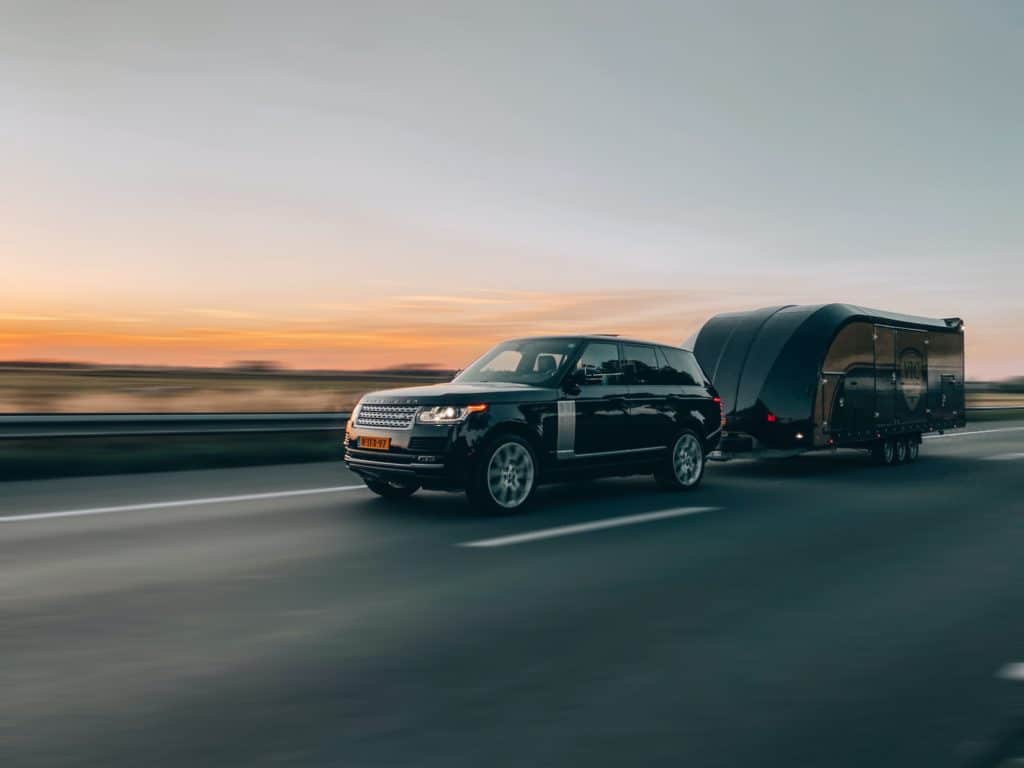
Trailers are practical and popular. DIY shopping, vehicle transport or for hobbies such as horse transport or motocross are typical areas of use. However, you soon realise that your own car is more difficult to steer. When accelerating and braking, the trailer behaves completely differently to the towing vehicle alone.
In this guide, we explain which insurance company has to pay for the damage in the event of an accident involving a trailer and the three distinctions you should be aware of in the event of a road accident involving a trailer.
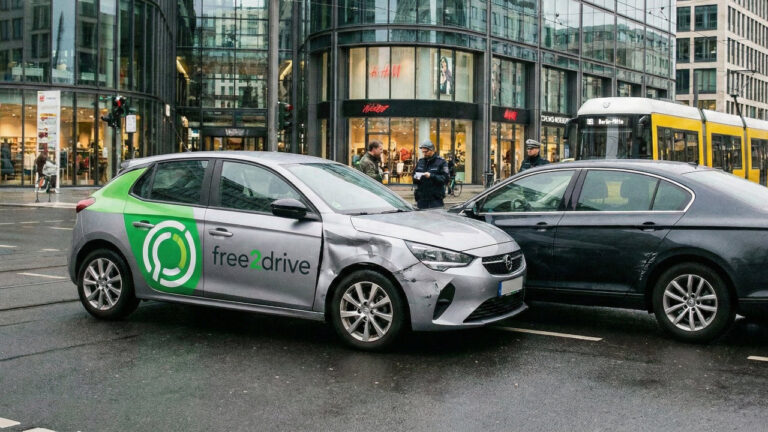
- An accident with the trailer is often due to the altered lane stability and the correspondingly influenced driving style of the vehicle.
- If you have an accident involving a trailer, two different insurance policies apply: One for the motor vehicle and another for the trailer.
- Damage to your own towing vehicle, your own trailer or the load being transported is not automatically covered by motor third-party liability insurance. In such cases, comprehensive insurance, transport insurance or claims arising from a hire or loan agreement may, amongst other things, be relevant.
- After an accident, you should secure the scene of the accident and, if necessary, notify the police and the emergency doctor and provide care for the injured.
- Some trailer hire companies require a police accident report after an accident.
- There are three different types of horse trailer accident. We explain these here in our guide.
What causes an accident with a trailer?
Anyone who has ever driven a car with a trailer knows that the vehicle’s stability is significantly affected. Additional risks often arise from incorrect or inadequate load securing. Inexperienced drivers of vehicle-trailer combinations often find it difficult to correctly assess the larger dimensions or the increased weight of the combination. Very few drivers regularly tow a trailer and are therefore often overwhelmed by the changed handling characteristics. Not least, combinations are significantly more susceptible to crosswinds and rocking movements.
Consequently, a lack of driving experience with a car and trailer combination is a common cause of accidents.
Which insurance pays out in the event of an accident with a (borrowed) trailer?
Third-party motor insurance is a legal requirement for your car. A car trailer that is subject to registration and insurance requirements also generally needs its own third-party insurance. Exceptions apply to certain trailers that are exempt from registration.
If a combination of a towing vehicle and a trailer causes damage to another road user, both the owner of the towing vehicle and the owner of the trailer may be held liable. They are jointly and severally liable to the injured party. The injured party therefore does not have to apportion the loss between the two insurers themselves.
The question of which party will ultimately bear the costs will then be settled between the parties involved. As a general rule, the owner of the towing vehicle is liable for the damage. The trailer’s insurance will only be involved if a specific risk associated with the trailer contributed to the accident. This may be the case, for example, in the event of a technical fault, the trailer veering off course or the trailer rocking. Simply towing the trailer is not usually sufficient for this.
In the case of a borrowed or hired trailer, the towing vehicle and the trailer are often owned by different people and insured by different insurers. A typical example is a DIY store trailer being towed by your own car. In terms of liability towards a third party who has suffered damage, this makes no difference in principle.
You should also take note of the terms and conditions of the hire or loan agreement. These may specify how quickly the accident must be reported, whether the police should be notified, and what excess applies in the event of damage to the trailer.
First, report the accident to the third-party liability insurer of the towing vehicle. If the trailer is borrowed or hired, you should also inform the owner or hire company immediately. If you have suffered damage caused by a combination of vehicle and trailer through no fault of your own, you do not need to divide your claim between the insurance companies of the towing vehicle and the trailer yourself.
Accident victims in your situation simply get the best support from fairforce.one.
Depending on the cause of the accident, customers receive an average of €4802 Additional payment
Callback within 5 minutes.
Who pays for damage to the towing vehicle, the trailer and the load?
Motor vehicle third-party liability insurance is, in principle, intended to cover legitimate claims for compensation made by other people. Damage to your own towing vehicle, your own trailer or your own load is therefore not automatically covered by third-party liability insurance.
If your own trailer is damaged in an accident caused by you, comprehensive insurance for the trailer may cover the damage, depending on the terms of your insurance policy. By contrast, third-party liability insurance for trailers alone does not usually cover damage to your own property.
The towing vehicle’s comprehensive insurance may cover damage to the vehicle itself. In this context, the agreed excess, any potential downgrading of the no-claims bonus and the specific terms and conditions of the insurance policy must be taken into account.
Damage to cargo such as furniture, machinery, motorbikes or sports equipment is often not covered, or only covered to a limited extent, by motor vehicle third-party liability or comprehensive insurance. Separate transport insurance may be required for valuable cargo.
In the case of a hired trailer, the hire agreement also determines whether comprehensive insurance or a limit on liability applies. In particular, the hirer may be held personally liable if they have coupled the trailer incorrectly, overloaded it, used it in breach of the agreement, or caused the damage through gross negligence.
What if the trailer damages your own or a borrowed towing vehicle?
If a trailer causes damage to the vehicle to which it is coupled, different rules apply than in the case of damage caused to a third party involved in an accident.
Liability for damage to one’s own property between the owners of the towing vehicle and the trailer is governed by the general provisions. The mere risk inherent in the operation of the trailer is therefore not automatically sufficient to give rise to a claim for damages. As a rule, specific fault must be proven, such as an error in coupling, a lack of maintenance or the handover of a trailer that was recognisably unsafe.
In its judgement of 10 February 2026, the Federal Court of Justice confirmed that, as a general rule, there is no strict liability between the owners of the towing vehicle and the trailer for such internal damage to the combination. This may also apply if the trailer becomes unintentionally detached from the towing vehicle in connection with the accident.
Anyone using a trailer that does not belong to them should therefore check the condition of the coupling, the safety devices and the braking system before setting off. In the event of damage, it is particularly important to preserve evidence accurately so that the exact cause can be established.
Special case: Horse trailer accident
In the event of an accident or damage involving a horse trailer, a number of different scenarios must be taken into account.
Accident caused by the articulated lorry
If a car towing a horse trailer causes damage to another road user, the same liability rules generally apply as for other vehicle combinations. Externally, both the owner of the towing vehicle and the owner of the horse trailer may be liable. Internally, the party responsible for the towing vehicle usually bears the cost of the damage, provided that no specific risk associated with the trailer has materialised.
Horse damages the trailer
If the horse being transported causes damage to a third-party, hired or borrowed trailer, the animal owner may be liable for the damage incurred under Section 833 of the German Civil Code (BGB). This is subject to the condition that a typical animal-related risk has materialised, for example because the horse kicks out, panics or damages parts of the trailer’s fittings.
For animals used in the animal keeper’s profession, gainful employment or livelihood, Section 833 of the German Civil Code (BGB) provides for a possibility of exoneration under certain conditions. This exception does not normally apply to privately kept horses.
Whether a horse owner’s liability insurance covers the damage depends on the specific terms and conditions of the policy. Damage to rented, borrowed or leased movable property may be excluded, covered only to a limited extent, or subject to an excess. The insurance cover should therefore be checked before transport.
Horse injured by a faulty trailer
If a horse is injured as a result of a technical fault or defect in a hired trailer, claims for damages may be made against the hirer. In the case of a hire agreement for a fee, Section 536a of the German Civil Code (BGB) may be particularly relevant if the fault was already present at the time the contract was concluded, if the lessor is subsequently responsible for it, or if the lessor is in default of rectifying it.
In the case of a loan granted free of charge, the lender’s liability is, in principle, limited to intent and gross negligence in accordance with Section 599 of the German Civil Code (BGB). However, if the lender fraudulently conceals a defect of which he is aware, he may nevertheless be liable for the resulting damage in accordance with Section 600 of the German Civil Code (BGB).
The decisive factors are always the cause of the fault, the condition of the trailer at the time of handover, the maintenance carried out, any instructions given by the hire company, and whether the user should have noticed any obvious defects.
Three important steps to take following a trailer accident
After a road accident involving a trailer, you should always follow these three steps:
- Secure the scene of the accident so that further danger or a rear-end collision can be avoided.
- Depending on the extent of the accident, you should then call the police and an ambulance. You can answer the most important questions about the accident by asking the W questions (Where? What? How? What injuries?). Be sure to wait for further questions and do not hang up immediately. You can find out when you should call the police about an accident in this guide article.Note
Some trailer hire companies also require a police accident report for minor accidents. It is best to ask what to do in an emergency before you set off.
- Provide first aid if people have been injured. Try to prevent the injured person's condition from deteriorating and reassure them.
Accident victims like you get the best support from fairforce.one.
Have your accident reported now free of charge and without obligation by our regulation specialists.
Your path to a fair claims settlement
Have you been involved in a trailer accident and have some questions? If so, it’s best to get in touch with fairforce.one as soon as possible. Here’s an overview of the tried-and-tested procedure:
- You report the accident to us risk-free and free of charge by telephone on 0800 30 111 60 or even faster Rate this post now:[0/5 from 0 Reviews]