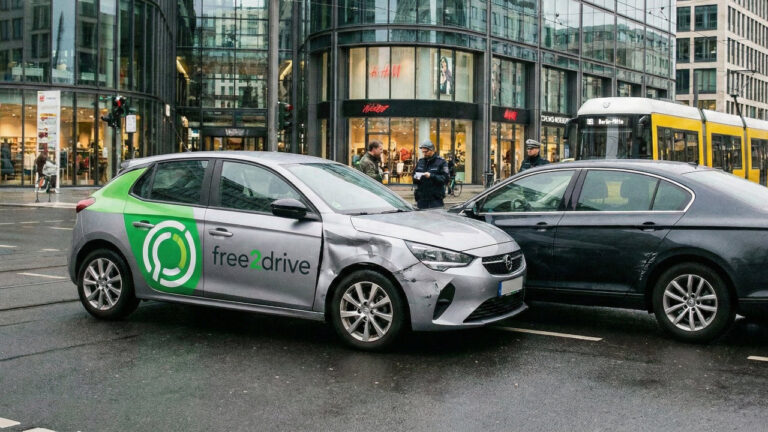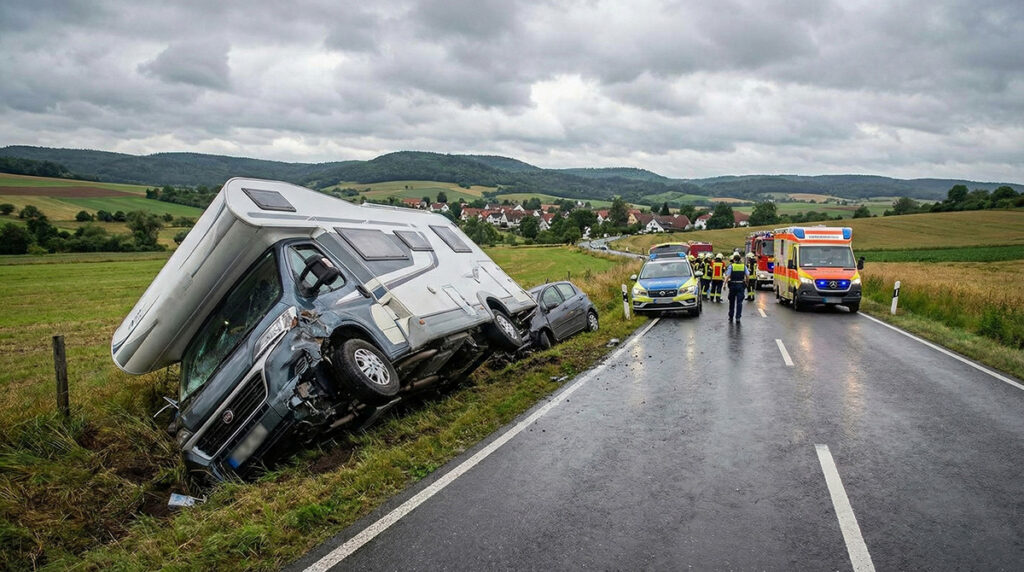
Motorhomes stand for freedom, flexibility and holidays off the beaten track - but they also involve special risks. Due to their size, weight and often lack of driving experience, motorhomes are more prone to accidents than normal cars. If you don't know how to react correctly or which insurance company is responsible, you risk unnecessary trouble and high costs.
This guide shows you what is important after a motorhome accident, who is liable and how to assert your claims correctly.
- Motorhome accidents are often caused by a lack of driving experience, incorrect load securing and misjudgement of weight and dimensions.
- The risk of accidents can be significantly reduced by correct loading, adherence to the payload limits and driver training.
- After a motorhome accident, the same rules of behaviour apply as for any traffic accident.
- In the event of an accident through no fault of your own, the insurance company of the person responsible for the accident usually covers the damage - including to the inventory.
What can cause an accident with a motorhome?
Motorhomes are often only driven in the beautiful summer months. The rest of the year, many motorhome fans are travelling in a normal car. The lack of driving experience with motorhomes, together with ignorance of vehicle behaviour, regularly leads to motorhome accidents. Drivers are also often not used to the larger dimensions of their motorhome or disregard the significantly higher weight of their caravan.
How can the risk of accidents be reduced?
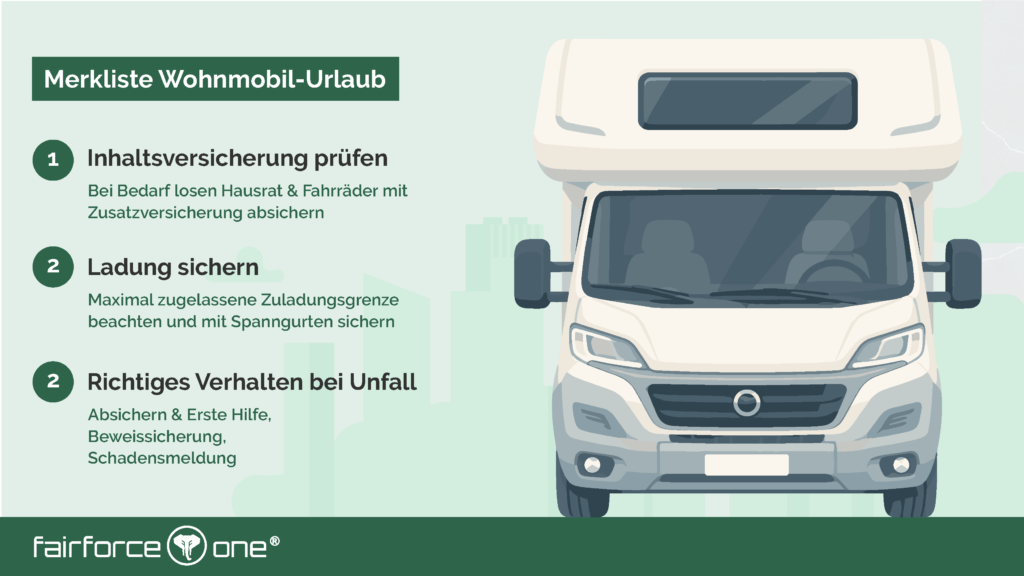
The key word here is: Load securing. Properly securing the load can be vital in the event of a crash! This is why Section 22 of the German Road Traffic Regulations (StVO) stipulates that the load must not slip, fall over, roll back and forth, fall down or generate avoidable noise, even in the event of emergency braking or sudden evasive manoeuvres.
Therefore, please note that heavy objects should be stowed on or near the floor in the motorhome interior using lashing straps. Only lighter objects should be stored on the shelves and higher levels of the motorhome interior. Fragile and splintering objects are best left at home.
It is particularly important that you do not overload your motorhome. Information on the maximum permitted payload can be found in the vehicle registration document or the registration certificate.
Our tipPractice with your unloaded motorhome or caravan before a longer journey. Use traffic-calmed routes and gain valuable driving experience. Driver assistance systems can also be a good support on longer journeys.
Correct behaviour after the accident
Unfortunately, even with all conceivable precautions, a motorhome accident cannot be ruled out one hundred per cent. If an accident does occur, you should follow a few basic rules.
This checklist will help you:
- Keep calm and maintain an overview.
- First secure the scene of the accident. To do this, first switch on the hazard warning lights, put on the high-visibility waistcoat and set up the warning triangle in front of the accident site.
- Then take a look around to see if anyone has been injured or if there is only body damage.
- Injured? Provide first aid and contact the police and the emergency doctor.
Make sure you stay with the injured person until the emergency services have arrived and give the emergency services a detailed description of the scene and what has happened. - You can read a detailed list of what to do after a road accident here.
NoteAfter a motorhome accident, you should also think about replacing the child seat. Hairline cracks, which can occur at an impact speed of 10 km/h or more, mean that protection is no longer guaranteed in the event of another impact. These cracks are not visible to the naked eye.
Who pays in a motorhome accident?
In contrast to caravans, where both the car and the caravan trailer must have their own insurance, there is only a single insurance policy for motorhomes. This insurance covers you if you cause an accident. Damage to the motorhome of the person who caused the accident is covered by partial or fully comprehensive insurance - provided the conditions are met.
If you are involved in a motorhome accident through no fault of your own, the insurance company of the person responsible for the accident must pay for any damage and possible claims for compensation. The damage must therefore be claimed correctly from the insurance company of the person responsible for the accident. We will take care of this for you in a competent and uncomplicated manner.
Accident victims like you get the best support from fairforce.one.
Have your accident reported now free of charge and without obligation by our regulation specialists.
Is the inventory also insured?
Some motorhome owners invest a lot of money and even whole years in upgrading their beloved motorhome.
But what about insurance for the interior fittings and fixtures and fittings?
Again you must Distinguish between two scenarios:
A) You yourself are at fault for the accident, or it is a case of burglary or forces of nature
Then it's a question of the scope of cover you have insured yourself, i.e. your comprehensive insurance, your inventory insurance and, if applicable, your household contents insurance with the external insurance feature.
The insurance company differentiates between equipment and accessories that are permanently installed in the motorhome and equipment and accessories that can be removed with little effort.
Accessories permanently installed in the motorhome or permanently attached to the motorhome are always covered by comprehensive motorhome insurance. In addition to the TV screwed into the interior, this also includes the solar system permanently attached to the outside or the satellite dish if it has been permanently installed on the roof. Awnings, canopies and awnings are generally only insured if they are permanently attached to the motorhome.
Loose objects are not covered by comprehensive insurance. This mainly applies to standard household contents such as duvets, kettles, cushions or pots. A separate contents insurance policy is required to insure these as well.
Good to know: Very often Bicycles on the rear rack and taken along on the journey. These are not covered by the normal comprehensive insurance. This is also covered by a separate Contents insurance.
B) You are involved in an accident with your motorhome and its contents through no fault of your own
In this case, the liable party is also the address for your compensation claims for any inventory, accessories and equipment damaged in the accident. This involves providing the correct list and evidence of the replacement value of the items damaged in the accident - including installation costs in the case of permanently installed equipment, of course. You should always entrust this quantification to an experienced, insurance-independent settlement specialist.
The difference between "Ask the insurer what he wants to pay" and to provide the insurer with a concretely calculated claim regularly amounts to several thousand euros for the injured party.
Accident victims in your situation simply get the best support from fairforce.one.
Depending on the cause of the accident, customers receive an average of €4802 Additional payment
I'll call you back in a few minutes.
Does normal household contents insurance also cover luggage and inventory in the event of burglary or an accident caused by the insured person?
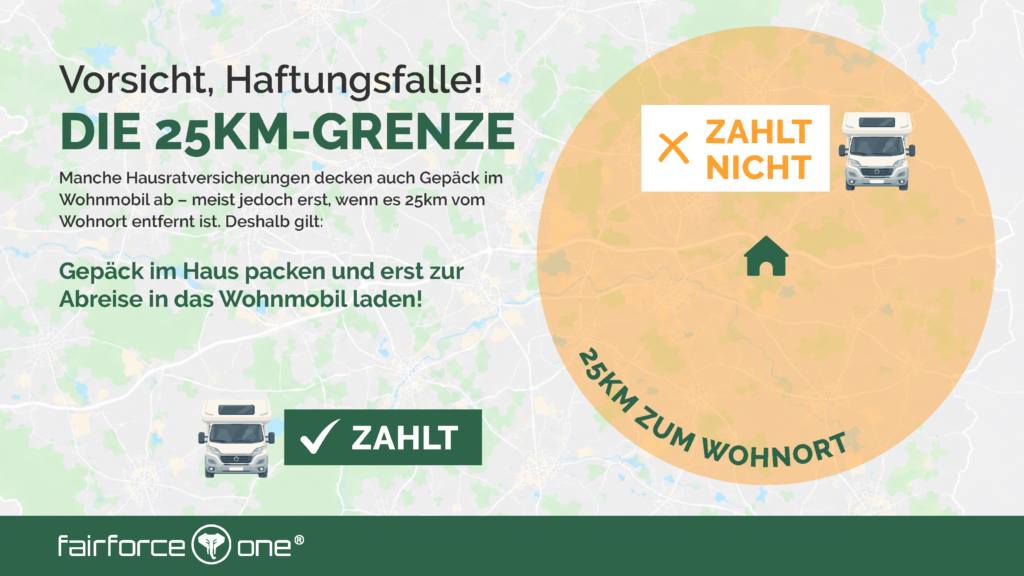
Some Household contents insurance also insures household contents and luggage outside your own four walls as part of the external insurance - for example, when travelling in a motorhome. But be careful! The small print usually states that luggage is only covered if the damage occurs at least 25 kilometres from the place of residence.
ATTENTION, liability trap:
People are all too happy to leave on holiday in the very early hours of the morning. The motorhome, which is already fully packed, is made ready for departure from the front door. If a break-in occurs here, there is often no cover due to the above-mentioned clause.
Read the small print or play it safe and only really load the vehicle when you start your journey.
Many Household contents insurance, on the other hand, does not offer suitable cover for the loose, much-loved items in your own motorhome. In this case, separate contents insurance is recommended.
The right steps for fair claims settlement
Have you been involved in an accident through no fault of your own? Then play it safe and contact us directly:
- Our competent team of experts will discuss the right next steps with you.
- If required, we can organise an expert to come to your home. He will prepare the important independent expert opinion
- Your full claims are calculated by specialised teams of lawyers using our software
- Your optimised claims are asserted with the insurance companies liable to pay benefits and paid out for you
- If required, our network of tested, reliable specialist workshops and replacement vehicles will support you
- You will be kept up to date on all regulatory progress via our innovative HIS (customer information system).
We can't undo your accident. But we will make the best of it for you, we promise!
Frequently asked questions about accidents involving caravans
Who is liable in the event of an accident with a motorhome?
If an accident occurs through no fault of your own, the other party's motor vehicle liability insurance is liable for all damage - to the vehicle, contents and, if applicable, compensation for pain and suffering. In the case of accidents caused by your own fault, your own comprehensive insurance will apply, if you have taken out one.
Is the inventory of my motorhome also insured in the event of an accident?
In the event of a self-inflicted accident, only permanently installed or bolted parts (e.g. solar system, awning, television) are covered by comprehensive insurance. Loose items such as kitchen utensils or personal equipment require separate contents insurance or, if applicable, household contents insurance with external insurance.
If you are involved in an accident through no fault of your own, the other party's liability insurance will apply.
How can I avoid accidents with my motorhome?
Through regular driving practice, training with the loaded vehicle, consistent load securing and adherence to the maximum payload. It is also important to drive with foresight and to be supported by driver assistance systems if you are unsure.
What happens if the motorhome is broken into before departure?
If the loaded motorhome is parked outside the front door, most household contents insurance policies do not cover it. A separate contents insurance policy offers much better protection here - especially for high-value equipment.